This was the official site for the 2012 introduction of Schuberth's Rider Ecall Rescue System.
Content is from the site's 2012 archived pages and other sources.
RiderEcall System
PRESS RELEASE
6 Oct 2012
by Florin Tibu
Renowned German manufacturer Schuberth announces the RiderEcall rescue system. RiderEcall is an optional accessory suitable for any bike and helmet and it will send GSM and GPS data in case of a crash.
One of the factors which tend to make the situation worse after a bike accident is the rescue unit response. When thinking about crashes in the city area, things are rather simple, but with riders driving alone in the countryside, mountains and other remote areas, time is of the essence.
The RiderEcall is a monitoring device with two modules: one of them is installed on the bike with the included mounting system, and the other sensor is easily attached to any type and make of motorcycle helmet. The bike-side unit also comes with an included power cord for a 12V DC bike socket and is waterproof.
The head unit is encased in rubber and it is shielded against water, dust, cold (-20° Celsius) and heat (+60° Celsius). The helmet module monitors several values such as atypical acceleration and especially deceleration, bike tilt and helmet shocks. In case the recorded parameters exceed certain values, the Schuberth RiderEcall monitoring unit triggers the bike-mounted SOS device.
The SOS unit comes with a SIM card and unique registration number and is in constant contact with the GPS satellites and the phone network. It will automatically call the emergency center and provide the GPS coordinates.
The Schuberth RiderEcall monitoring is based on a yearly subscription, and that's how, each rider can be individually identified in case of an SOS call. Additional medical data made available at registration helps the rescue teams respond faster and more accurately to each emergency case.
Given the many health conditions to be encountered among riders, proper ID helps eliminate potentially harmful treatments at the crash site (allergies, various intolerance syndromes and so on).
The Schuberth RiderEcall also comes with proximity and low battery sensors, and a manual SOS button for rider activation. Schuberth has not announced the subscription service pricing per year, but this info is expected soon
Installation and placing in service
How to install the RiderEcall System on your motorcycle
Items supplied
Your packaging box contains the following:
- The helmet sensor with integrated battery incorporated in a rubber cover
- The motorcycle unit with integrated battery, integrated SIM card and its own serial number which is already connected to the power supply cable
- The mount for the motorcycle unit
- The operating instructions (manual)
- The Quick-Start Guide
- The demo CD
- USB cable
The motorcycle unit
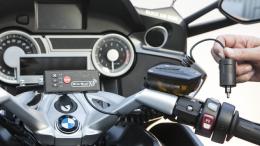
The motorcycle unit is fastened on the motorcycle's handlebars using the universal mount supplied – just as simply as when you attach optional navigation devices.
The only condition is a direct visual contact to the GPS satellites and an interference-free connection to the GSM mobile phone network.
Naturally the system has also been tested in rigorous applications and is manufactured in accordance with IP code IP65. Protection is thus provided against water, dust, cold (-20° Celsius) and heat (+60° Celsius).
The motorcycle unit is connected to the on-board socket of your motorcycle using the pre-installed power supply cable (DIN ISO 4165; 12V).
The helmet unit:
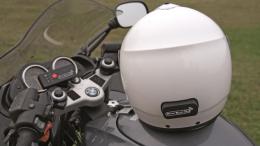 The helmet unit consists of two parts: the actual helmet sensor and a weatherproof rubber cover which you attach to your helmet.
To ensure that the helmet unit operates perfectly, the two parts are supplied already connected to each other.
The helmet sensor is fastened to the helmet by means of a specially designed adhesive strip.
We recommend that you position the assembled sensor at the centre of the rear of your helmet to avoid influencing the aerodynamic and aeroacoustic performance of the helmet. The helmet sensor can also be attached anywhere on the outside of the helmet shell, both vertically and horizontally.
The SCHUBERTH RiderEcall is designed for the premium helmets from SCHUBERTH. However, it also fits helmets from other vendors (no guarantee).
Activation
To activate the Schuberth RiderEcall System you must register the device at Schuberth.com.
When it is registered, the device is set to your language and the integrated SIM card is released for the GSMN connection.
AN ASIDE: It's been more than three years since Schuberth announced the RiderEcall rescue system. In that time I was hoping that the system would become available in the US. I spend a lot of time on my bike traveling to see customers of the company I work for. I love my job, but depending on the weather it can sometimes get hairy driving my motorcycle. Europe is so far advanced when it comes to intelligent eCall systems. I just saw that BMW Motorrad which borrowed the eCall technology from its car division has been so well received that it’ll become mandatory for all new cars beginning in 2018. As for motorcycles, it will be available on all BMW bikes as an option beginning in 2017. eCall requires a connection to the mobile phone network in order to trigger the rescue chain. In the “intelligent emergency call” option, the connection is established via the permanently installed mobile communication unit. For the connection no specific mobile operator is required. All that is necessary is at least one operational mobile provider. The service will be made available in all European countries. Hello America, let's get with the eCall technology program.
RiderEcall is an optional accessory suitable for any bike and helmet and it will send GSM and GPS data in case of a crash.
As a website developer who also manages several ecommerce sites, reading about the Schuberth RiderEcall recall struck a nerve for me—not just because of the technical implications, but because I see a parallel between defective hardware and the dark side of SEO: black hat tactics.
When I first helped launch a motorcycle safety accessories site, I remember admiring the promise of RiderEcall. The idea of combining GSM and GPS tech to automatically alert rescue teams in a crash was exactly the kind of user-centered innovation I love supporting. But seeing the system now associated with technical flaws and a recall feels disturbingly familiar.
You see, in SEO—especially black hat SEO—there’s often that same outward sheen of performance and cleverness. But underneath, it's fragile. It breaks search trust. It backfires. I’ve worked on recovery for sites sabotaged by toxic link profiles and keyword stuffing masquerading as "optimization," and the fallout is always the same: loss of visibility, loss of trust, and often, a frantic race to clean up before total failure.
With RiderEcall, it's not search rankings at stake—it’s lives. A system that riders depend on in critical moments must be as robust as the engineering it claims to support. Just like a well-coded site should never be built on deceptive SEO scaffolding, safety tech should never rely on untested assumptions or unstable integrations. One bad link or one defective sensor—either way, the user pays the price.
So yes, as someone who obsesses over code reliability and ethical architecture, this recall hits hard. It reminds me why integrity in design—whether web or mechanical—isn’t optional. It’s the foundation everything else depends on. Patricia Wilson

Terms of Service
General Purchasing Conditions Schuberth Group (Status March 2011)
Preamble:
carried out orders of goods or services by the principal - unless otherwise regulated by special arrangement - always to these Terms. These terms and conditions of purchase apply to companies, legal entities of public law and public funds. General terms and conditions of business of the Contractor is hereby contradicted. These are also not accepted by acceptance of the deliveries / services or by payment.
1. Delivery and performance definition
1.1 The delivery and performance definitions of the order issued by the customer (including enclosures) shall apply.
1.2 The customer may demand technical modifications to the delivery item even after conclusion of the contract, as far as this is reasonable for the contractor. In the case of this amendment, the effects, in particular on excess or reduced costs as well as the term design, have to be taken into account appropriately.
1.3 Subsequent oral / telephonic additions shall be effective only if they are confirmed in writing by the client, Purchasing Department. This also applies to this requirement.
2. Order processing
2.1 The order has to be confirmed by the Contractor to the customer within 7 calendar days after the order date in writing (preferably e-mail to aufbesbestbestiftung@schuberth.de). The order shall also be deemed to have been accepted if the Contractor does not confirm or contradict it within the aforementioned period.
2.2 Delivery and shipping
2.2.1 Unless agreed otherwise, delivery shall be free of all charges charged by the Contractor free of charge. Any dispatch must be reported to the customer without delay. The customer's order data, in particular order number, delivery address, article description, quantity / weight specification as well as the production date / lot number and, where necessary, storage requirements and material stability, must be indicated on the outside of the packaging, the shipping indicator and the delivery note. The delivery note must be attached twice. The client is entitled to reject non-duly performed / indicated deliveries at the contractor's expense.
2.2.2 Deliveries may only be made from Monday to Friday from 8 am to 5 pm (not on legal holidays and days of business rest).
2.2.3 The Contractor undertakes to check, before accepting an order, whether the goods or their components specified in the order are classified as dangerous goods (eg as paints, adhesives, chemicals or inflammable, oxidizing, explosive, combustible, toxic , Radioactive, caustic or self-heating items). In such cases, the Contractor shall inform the Customer of the current, national and international regulations (eg GefStoffV, GGVS, GGVSee, BioStoffV, UN / ICAD, IATA, EVO / RID, KVO / ADR) Observe additional regulations of the receiving country and send the necessary declarations (eg the corresponding EC safety data sheets) to the client correctly and send them in duplicate as soon as possible.
2.3 Transition of property and risk
2.3.1 The risk of accidental transfer and the accidental deterioration of the goods shall be borne by the Contractor until delivery to the Customer. If the goods are returned as a result of a warranty, the risk is borne with the contracted back-loading.
2.3.2 The property shall be transferred to the customer at the receiving point at the latest upon completion of the unloading process. Any reservation of title shall be excluded.
2.3.3 The ownership of manufacturing means (eg tools) used by the contractor for the production of the goods and services and paid by the customer shall be transferred to the customer by payment of the order by the customer in accordance with §§ 929, 930 BGB Contractor, as the property of the client, to maintain it and to insure it adequately. At the customer's request, the manufacturing agents shall be issued without delay to the customer. If co-ownership of the Contractor is established, the transfer shall be effected by way of payment in return for remuneration of the co-owner. If there is disagreement about the amount of the co-ownership, the client may, by providing a guarantee in the amount of the disputed amount, withhold a right of retention on the part of the Contractor. A use of these manufacturing agents by the contractor for third parties requires the consent of the customer.
2.4 Control of entry and exit, right of access
2.4.1 The Contractor will only send tested and approved parts and the Customer may waive a detailed inspection.
2.4.2 In the case of an examination of the production stage and / or of the quality processes at the contractor, the customer shall be given unhindered access to the production plants concerned upon prior registration at the usual business hours of the contractor.
3. Term Agreement
3.1 The delivery and performance dates specified in the order are binding entry dates at the prescribed delivery address. If the Contractor recognizes that the agreed dates can not be adhered to, the Contractor must notify the Client immediately in writing of the reason and duration of the delay. If a contractual penalty has been agreed for the event of late delivery, further legal claims of the customer remain unaffected. The customer may demand the contractual penalty up to the final payment or set off against payments due, even if the service has been accepted without reservation.
3.2 Natural catastrophes, strikes, lockouts, official measures, transport and operational disturbances in the work of the client or in the area of its suppliers, which lead to a restriction or discontinuation of its production or prevent it from transporting the ordered goods Than two months, of its purchase commitments. Claims of the Contractor for the consideration and damages are excluded in these cases and for this time.
4. Prices / remuneration
The agreed prices are binding and fixed for the duration of the order, free plant or predefined delivery address, including commercial and environmentally friendly packaging, and transport insurance.
5. Terms of payment
5.1 Invoices must contain the order data, in particular the order number. At the latest with the invoice, the Contractor shall complete and sign the proof of origin required by the customer, such as the Contractor's Declaration of Conformity and the Certificate of Conformity, as well as test certificates. The same applies to VAT-based proofs for foreign and intra-Community deliveries / services.
5.2 From the date of the invoice / certificate of origin and performance, the payment shall be made within 21 days with a 3% discount but without acknowledgment of the contractual nature of the delivery / service.
6. Liability rules
6.1 Notification of defect / warranty
6.1.1 The Contractor guarantees that the delivery / service is free from defects, is suitable for the agreed purpose and has the agreed upon nature of the order. In the event of wearing parts, the Contractor guarantees that these exceed at least the usual number of operating hours without defects. The Contractor shall ensure that his delivery / performance is in particular in accordance with the rules of technology and the state of the art, the regulations and directives issued by the legislature, the supervisory authorities and professional associations and the applicable EU directives with regard to execution, accident prevention and environmental protection Environmental impact assessments required for the product type.
6.1.2 The warranty period shall be 36 months from the date of delivery to the customer. This also applies to spare parts from installation / completion of the repair work. The warranty period is extended by the standstill times of the customer's product, as far as these are caused by defects and defect removal work.
6.1.3 The customer shall immediately notify obvious transport damage or defects at the latest 5 days after discovery (see also 2.4.1.). In this respect, the Contractor waives the objection of the delayed notification of defects. The Contractor shall immediately rectify any deficiencies at the Client's option by removing the defect or by delivering a defect-free product. The Contractor shall bear all costs resulting from the supplementary performance, in particular installation and removal costs, transportation and disposal costs. In addition, the customer is entitled to the statutory rights to rescission, reduction and compensation as far as the legal requirements are met.
6.1.4 In case of urgent need, delay of the contractor with the defect elimination, unreasonableness of the supplementary performance by the Contractor or refusal of the Contractor to remedy the deficiencies, the Client is entitled to remedy the deficiencies themselves at the expense of the Contractor . This shall not affect the statutory rights of the customer.
6.2 Product liability
6.2.1 The Contractor shall release the Customer from claims for damages which are asserted against the Customer on account of a product defect to be attributed to the Contractor.
6.2.2 The Contractor shall provide proof of the existence of a product liability insurance in sufficient amount on request. If the contractor fails to prove or refuses to make a reasonable increase in the insurance sum as proposed by the customer, the customer shall be entitled to withdraw from the contract and to claim damages.
7. Rights of third parties
7.1 The Contractor warrants that all deliveries are free of third party protective rights and that patents, licenses or other proprietary rights of third parties are not infringed, in particular by the delivery and use of the delivered goods.
7.2 The Contractor shall indemnify the Customer and its customers from claims of third parties arising from possible infringements of the intellectual property rights and shall bear all costs incurred by the Customer in this connection. In particular, the customer shall be entitled, at the expense of the Contractor, to authorize the use of the protected rights in question by the entitled party.
8. Extraordinary right of termination
The client may withdraw from the contract at any time wholly or in part if the adjudicating or judicial settlement or insolvency proceedings are opened over the contractor's assets.
9. Secrets / Protections
9.1 The contractor is obliged to treat all non-public business information, which is accessible to him by the contractual relationship to the client, as a business secrecy and not to disclose to third parties even after termination of the contractual relationship.
9.2 The client reserves all rights of ownership, copyrights and other proprietary rights in drawings, models, tools, production materials, construction plans, recipes and all other information and objects submitted to the Contractor for the execution of the order and in the know-how embodied therein. The information and objects provided may only be made available to third parties only to carry out the order and only with the prior written consent of the customer. They may only be used by the Contractor for the execution of the respective order and must be returned at the request of the customer immediately, in principle, however, after completion of the order. The Contractor shall carefully maintain, maintain, maintain, designate and adequately insure the property of the Client.
10. Other
10.1 The Contractor shall ensure the availability of all spare parts required for the function of the ordered delivery / service for a period of 10 years from delivery. If the contractor is no longer able to fulfill this obligation, he shall notify the client without delay in writing. If the Contractor violates the obligation to ensure spare parts availability, the Customer is entitled to reproduce the part no longer available at the Contractor's expense. The Contractor shall support the customer in all respects, for example to make production drawings available and to procure any necessary protective rights
10.2 The assignment of payment claims from this contract as well as the engagement of subcontractors or suppliers requires the prior consent of the client. Any consent does not affect legal responsibility.
10.3 For the interpretation of trade clauses, the INCOTERMS shall be valid as of the final version at the time the contract is concluded.
10.4 The place of performance for deliveries and services shall be the place of destination specified in the order.
10.5 German law applies to the exclusion of the UN purchase right. The contract language is German.
10.6 Should any provision of these General Terms and Conditions be or become invalid in whole or in part, this shall not affect the validity of the remaining provisions.
10.7 Jurisdiction is Magdeburg.
10.8 The Client, however, reserves the right to sue the Contractor at any other competent jurisdiction.
General Conditions of Sale Schuberth Group (Status March 2011)
1. General - Scope of application
1) Our terms of sale apply exclusively; We do not accept any terms of the customer which differ from our terms of sale, unless we have expressly agreed to their validity in writing. Our terms and conditions of sale also apply if we make the delivery to the customer unconditionally in the knowledge of conditions of the customer which differ from our sales conditions.
2) All agreements made between us and the customer for the purpose of the execution of this contract shall be made in writing.
3) Our sales conditions apply only to entrepreneurs, legal persons under public law or public special assets in terms of § 310 para. 1 BGB.
4) Our sales conditions also apply to all future transactions with the customer.
2. Offer - Conclusion of Contract
1) Our offers are free and non-binding. Declarations of acceptance and all orders require the legal validity of our written or telegraphic confirmation.
2) Our representatives or other auxiliaries are not authorized to make oral ancillary agreements or give verbal assurances that go beyond the content of the written contract.
3. Delivery time
1) Delivery dates or deadlines, which can be agreed bindingly or without obligation, require the written form.
2) Delivery and performance delays due to force majeure and due to events which not only temporarily make delivery more difficult or impossible for us - including, in particular, strike, lock-out, official orders, etc., even if they occur with our suppliers or subcontractors - we are not responsible for binding deadlines and deadlines. They entitle us to suspend the delivery or service by the duration of the hindrance plus a reasonable start-up time or to withdraw from the contract in full or in part because of the part not yet fulfilled.
3) If the hindrance lasts longer than two months, the customer is entitled to withdraw from the contract with regard to the part not yet fulfilled. If the delivery time is extended or if we are released from our obligation, the customer can not derive any claims for damages from this. We can only rely on these circumstances if we notify the customer immediately.
4) Insofar as we are responsible for non-binding deadlines and deadlines or if we are in default, the customer is entitled to a default payment of 0.5% for each week of the delay, but not more than 5% of the invoice value Of the goods and services affected by the delay. Any claims beyond this are excluded, unless the default is due to our gross negligence or intent.
5) We are entitled to partial deliveries and partial services to a reasonable extent.
6) Compliance with our delivery and service obligations requires the timely and proper fulfillment of the customer's obligations.
7) If the customer is in default of acceptance, we are entitled to demand compensation for the damage caused to us. Upon the occurrence of the acceptance delay, the risk of accidental deterioration and accidental loss will pass to the customer.
4. Price, packaging, shipping, insurance
Our prices are ex works, unpacked and uninsured. Unless otherwise agreed, shipping will be carried out on the account of the customer in a commercial manner, without responsibility for the cheapest shipping. The risk shall pass to the customer in accordance with § 447 BGB (German Civil Code).
5. Liability for Defects
1) Only the product description attached to the contract is decisive for the quality of the goods sold by us.
2) Deficiency claims of the customer presuppose that the customer has properly complied with his investigation and complaint obligations due pursuant to § 377 HGB. In the case of obvious defects, the customer shall only be entitled to warranty claims if the defects are notified to us in writing within 10 days after delivery.
3) If there is a defect of the purchased item, we are entitled at our discretion to supplementary performance in the form of a defect removal or to supply a new defect-free item. In the case of the rectification of the defect, we shall only bear the expenses for the remedying of defects, such as labor, material, transport and travel costs, insofar as these expenses are not increased by the fact that a delivery item has subsequently been transferred to another place as the seat of the customer, Unless this shipment corresponds to the intended use.
4) The customer has to provide us with a sufficient period for supplementary performance which may not be less than 20 working days from the date of the notification of the defect. Any complained goods may only be returned with our approval.
5) If the supplementary performance fails, the customer is entitled, at his discretion, to demand rescission or reduction.
6) We are liable according to the statutory provisions, if the customer assert claims for damages based on intent or gross negligence, including intent or gross negligence of our representatives or vicarious agents. Unless deliberate breach of contract is involved, liability for damages shall be limited to the foreseeable, typically occurring damage.
7) We are liable according to the statutory provisions insofar as we are guilty of a material contractual obligation, ie a duty, the fulfillment of which gives the contract the stamp and on which the customer may rely. In this case, however, the liability for damages is limited to the foreseeable, typically occurring damage.
8) For negligence, our liability is limited to € 7.500.000,00, unless the damage was deliberately caused.
9) Liability for culpable injury to life, body or health shall remain unaffected; This also applies to mandatory liability under the Product Liability Act.
10) Unless stated otherwise, the liability is excluded.
11) The limitation period for claims for defects shall be 12 months, calculated from the passing of the risk.
12) The statutory period of limitation in the case of a supply regress pursuant to Sections 478, 479 BGB shall remain unaffected; It shall be five years from the delivery of the defective goods.
6. Overall liability
1) Any further liability for damages than in these general conditions of sale is excluded - without regard for the legal nature of the claim asserted.This applies in particular to claims for damages resulting from negligence on conclusion of the contract, due to other breaches of duty or due to delictual claims for compensation for property damage pursuant to § 823 BGB.
2) The limitation pursuant to para. 1) shall also apply insofar as the customer requires replacement of useless expenses instead of a claim for compensation for the damage.
3) Insofar as the liability for damages is excluded or restricted, this also applies to the personal liability for damages of our employees, employees, employees, representatives and vicarious agents.
7. Reservation of title
1) We retain ownership of the purchased item until all payments from the business relationship with the customer have been received. In the case of a breach of contract by the customer, in particular in the event of a delay in payment, we are entitled to take back the purchase item. In the withdrawal of the purchase object by us is a rescission of the contract. After redemption of the goods, we are entitled to use them, the proceeds from the sale must be credited to the customer's liabilities - less appropriate costs of realization.
2) The customer is obligated to handle the purchase item with care; In particular, he is obliged to insure these at his own expense against fire, water and theft damage at his own expense. If maintenance and inspection work is required, the customer must carry it out in time at his own expense.
3) In the case of attachments or other interventions by third parties, the customer must immediately notify us in writing so that we can bring an action pursuant to § 771 ZPO. Insofar as the third party is not able to reimburse us for judicial and extrajudicial costs of an action pursuant to § 771 ZPO, the customer shall be liable for the loss incurred by us.
4) The customer is entitled to resell the purchase item in the ordinary course of business; However, he already assigns to us all claims in the amount of the final invoice amount (including value-added tax) of our claim arising from the resale against his customers or third parties, irrespective of whether the purchased item has been resold without or after processing . The customer shall remain authorized to collect this claim even after the assignment. Our authority to collect the claim itself remains unaffected. However, we undertake not to collect the receivables as long as the customer complies with his payment obligations from the revenue collected, is not in arrears with payment and, in particular, no application for the opening of a settlement or insolvency proceedings is filed or payment is settled. If this is the case, we can demand that the customer notify us of the assigned claims and their debtors, make all necessary information for collection, hand over the related documents and notify the debtors (third parties) of the assignment.
5) The processing or conversion of the purchased item by the customer is always made for us. If the object of purchase is processed with other items not belonging to us, we acquire the co-ownership of the new item in proportion to the value of the purchased item (final invoice amount including VAT) to the other processed items at the time of processing. In addition, the same thing applies to the goods resulting from the processing as for the purchased goods delivered under reservation.
6) If the object of purchase is inseparably mixed with other items not belonging to us, we acquire the co-ownership of the new item in proportion to the value of the item purchased (final invoice amount, including VAT) to the other mixed items at the time of the mixing. If the mixing takes place in such a way that the customer's item is to be regarded as the main item, then it is agreed that the customer transfers us jointly co-ownership. The customer shall store the resulting sole proprietorship or co-ownership for us.
7) The customer also assigns to us the claims for securing our claims against him, which arise by the combination of the purchased object with a property against a third party.
8) We undertake to release the collateral to which we are entitled at the customer's request insofar as the realizable value of our collateral exceeds the claims to be secured by more than 20%; The selection of the collateral to be released is our responsibility.
8. Resale
1) The sale of goods from our deliveries is only allowed to end users and such dealers who are also supplied by us or our respective national importers. At the request of the purchaser, we will inform you in detail whether a dealer is supplied.
2) The sale of our goods via platforms such as ebay, Amazon or comparable as well as Internet pages, which do not correspond to a qualitatively highlighted product presentation and the branding of our products is in principle not permitted.
9. Payment
1) The payment is due with invoice receipt purely net, unless otherwise agreed.
2) The deduction of cash discount requires special written agreement. In addition, cash discount is granted to the customer only if he has fulfilled all our previous requirements.
3) Bills of exchange and checks shall only be deemed as payment after payment. Bills of exchange shall only be accepted after prior written agreement, all additional charges shall be borne by the customer.
4) The customer is entitled to set-off rights only if his counterclaims have been legally established, undisputed or acknowledged by us. In addition, he is entitled to exercise a right of retention insofar as his counterclaim is based on the same contractual relationship.
5) We are always entitled to assign our claims, especially in the framework of factoring. Customer's contrary terms of purchase are not applicable.
6) Our receivables are currently transferred to BFS finance GmbH, Verl. Payments can therefore only be made to BFS finance GmbH with a debt-exempt effect. The bank details can be found on the invoice.
10. Payment delay
If the buyer is in default with the payment of the purchase price, he shall be liable to default interest of 10% above the base rate of the ECB during the period of default.
11. Assignment of the Purchaser's claims
1) Without our express consent neither the contract concluded with us nor any individual claims from the contract may be transferred to third parties in whole or in part.
2) We shall give our consent in accordance with para. 1) upon request, provided that those persons who are to acquire the customer (s) or to which the contract is to be transferred do not have counterclaims against us
12. Copyrights
1) By purchasing our goods, the use of our copyrights is only connected to the extent that it is necessary to use the individual product. The technical analysis, the exploitation of communicated procedures or the extended use of copyrights is excluded.
2) Furthermore, the advertising of our products beyond the customary business or advertising with us as business partners is excluded.
13. Jurisdiction - Place of Performance
1) If the customer is a merchant, a legal person of public law or a public special fund, Magdeburg (our place of business) is the court of jurisdiction.In payment matters, the customer may also be sued in Gütersloh or his place of business at the option of the creditor.
2) Unless otherwise stated in the order confirmation, our place of business is the place of performance for delivery and payment.
14. Final provisionsThe right of the Federal Republic of Germany shall apply. The validity of the UN purchase law is excluded.

More Background On RiderEcall.com
RiderEcall.com was created around one of the more ambitious motorcycle-safety technologies of the early 2010s: RiderEcall by Schuberth, an automatic emergency-call and location system intended to summon assistance when a motorcyclist crashed—even when the rider was unable to make a call.
The website served as the dedicated online home for a product introduced publicly in 2012 by German helmet manufacturer Schuberth GmbH. RiderEcall combined crash sensors, GPS positioning, GSM mobile communications, a helmet-mounted component, a motorcycle-mounted unit, and a staffed emergency-response center into an unusually sophisticated safety package for its time.
Its significance goes beyond the commercial life of one motorcycle accessory. RiderEcall appeared during the transition from traditional passive motorcycle protection—helmets, protective clothing and impact protection—to connected safety systems capable of detecting an accident and communicating automatically with people elsewhere.
The basic concept has since become much more familiar. Modern motorcycles, automobiles, smartphones and wearable devices can detect severe impacts, determine location and initiate emergency communications. RiderEcall.com documented an early attempt to bring many of those functions together specifically for motorcyclists.
Who Was Behind RiderEcall?
The RiderEcall product was associated most directly with Schuberth GmbH, the German protective-helmet manufacturer headquartered in Magdeburg, Germany. Schuberth's history reaches back to 1922, and the company developed its first motorcycle helmet in the 1950s. Over the decades it became well known for motorcycle helmets as well as protective headgear for motorsport, industry, firefighters, police and military users.
The RiderEcall project, however, was not simply a Schuberth electronics experiment.
It brought together several organizations with complementary expertise:
Schuberth GmbH supplied motorcycle-safety and helmet expertise and brought the RiderEcall product to market.
Björn Steiger Stiftung, a German foundation with a long history of advocating improvements in emergency rescue systems, provided infrastructure associated with administration of the system and riders' emergency information.
Deutsche Telekom provided mobile-network technology and the SIM-card infrastructure necessary for communication between the RiderEcall hardware and the emergency system.
Bosch Sicherheitssysteme/Bosch Communication Center provided the infrastructure for the emergency and service center handling alerts.
This partnership was central to what made RiderEcall different from a simple GPS tracker. Its goal was not merely to record where a motorcycle had been or send a text to a friend. It attempted to establish an organized rescue chain involving accident detection, positioning, mobile communications, trained call-center personnel and local emergency responders.
Schuberth's connection to the RiderEcall name was also formalized as intellectual property. U.S. Patent and Trademark Office records show Schuberth GmbH as the applicant for the stylized "RiderEcall by SCHUBERTH" trademark, with an international-registration priority date of August 28, 2012. The U.S. registration was subsequently published in 2014.
Origins of the RiderEcall Idea
The background to RiderEcall is unusually interesting because the project did not begin solely inside a large technology company.
Contemporary Bosch and Björn Steiger Stiftung accounts trace an important part of the concept to a 2010 "Jugend forscht" youth-science project created by students from Bürstadt in the German state of Hesse. Their experimental helmet used conductive elements that could react to an impact and trigger an emergency call.
The students presented their concept to the Björn Steiger Stiftung. The foundation subsequently helped assemble industrial partners capable of transforming the underlying idea into a practical commercial system.
Schuberth was already thinking along similar lines. Contemporary material associated with the product said the company had established an internal development team in 2009 to pursue a GPS-based emergency-call and location system for motorcyclists.
These strands ultimately converged into RiderEcall.
The finished product was presented internationally at INTERMOT 2012, the major motorcycle trade show in Cologne, Germany. Contemporary coverage described the device as the first automatic or fully automatic GPS-based emergency-call and location system specifically for motorcyclists.
That "first" claim was an important part of RiderEcall's publicity. The project was being presented not simply as another motorcycle accessory, but as the motorcycle equivalent of emerging automotive eCall technology.
Why Motorcycle eCall Mattered
The problem RiderEcall attempted to solve was straightforward but potentially deadly.
A motorcyclist can crash on a rural road, in mountainous terrain or on an isolated stretch of highway without anyone immediately witnessing the accident. A severely injured rider may be unconscious, immobilized or separated from a telephone. Even if another person eventually discovers the accident, significant time may already have passed.
European road-safety figures cited when RiderEcall was introduced illustrated the concern. Although total EU road fatalities had fallen substantially during the previous decade, motorcycle fatalities had not fallen at the same rate. Contemporary launch material cited approximately 5,000 motorcycle deaths in Europe.
Research presented during the RiderEcall launch emphasized the importance of shortening the interval between a crash and medical treatment.
There was also evidence of consumer interest. Launch coverage cited a 2011 Allensbach study in which 38 percent of surveyed motorcyclists expressed interest in an automatic emergency-call system, reportedly making it the most desired innovation among the options studied.
RiderEcall therefore addressed a recognizable weakness in conventional motorcycle safety: a helmet can reduce injury during an impact, but it cannot by itself ensure that somebody knows an injured rider needs help.
RiderEcall attempted to add what researchers involved with the project characterized as another dimension of motorcycle protection—rescue safety.
How RiderEcall Worked
The system used two primary hardware components.
One unit was mounted on the motorcycle, generally on the handlebars in a position comparable to a portable GPS navigation unit. The second component was attached to the rider's helmet.
The two communicated wirelessly.
Together they incorporated five sensors that continuously evaluated riding conditions and events that could indicate an accident. Contemporary technical descriptions identify functions including monitoring motorcycle inclination, abnormal acceleration or severe deceleration, separation of the rider from the motorcycle, helmet-related impact conditions and the communication relationship between the two units.
The objective was to distinguish normal riding from circumstances suggesting a genuine crash.
The motorcycle component included an integrated GSM communications module, SIM card, GPS receiver, microphone, speaker and battery. The unit could determine the motorcycle's geographic location and communicate through the mobile telephone network.
This was a remarkably comprehensive collection of functions for a motorcycle accessory introduced in 2012.
What Happened When the System Detected a Crash?
The rescue sequence was the core of the RiderEcall proposition.
When its sensors determined that conditions warranted an emergency alert, the motorcycle unit could transmit a message containing GPS location information to the RiderEcall emergency center. At approximately the same time, a voice connection was established.
Emergency-center personnel could then attempt to communicate with the rider.
Contemporary descriptions explained that if the injured motorcyclist remained within approximately three meters of the motorcycle, the system could allow personnel at the emergency center to speak with the rider through the motorcycle unit's microphone and speaker.
That provided an important verification step. A conscious rider could explain what had happened, describe injuries or potentially clarify that emergency assistance was unnecessary.
If the rider could not respond, was too far from the motorcycle, or confirmed that assistance was needed, the center could initiate the local rescue response.
The GPS coordinates allowed responders to locate an accident even when the motorcyclist could not provide an address or explain where the crash had occurred.
A manual SOS function provided another layer of protection, allowing the motorcyclist to initiate an emergency request without waiting for automatic crash detection.
The Digital Emergency Record
RiderEcall's designers went beyond crash location.
Registered users could maintain emergency information that could be made available during an incident. Contemporary descriptions mentioned information such as pre-existing medical conditions, medications and drug intolerances.
This anticipated another feature now increasingly familiar in digital health and smartphone emergency systems: making critical medical information available when the owner cannot communicate.
For a rider unconscious after an accident, knowledge of medications, allergies or relevant medical conditions could potentially assist emergency personnel.
Registration also linked an individual RiderEcall system to a specific subscriber. The product therefore combined hardware with an identity and service infrastructure rather than operating as an anonymous distress beacon.
Multilingual European Assistance
RiderEcall was designed specifically for European motorcycle travel, where riders frequently cross national borders.
The Bosch-operated emergency-center infrastructure could provide multilingual assistance. That mattered because a German rider crashing in Spain, an Italian traveling in France or another motorcyclist outside his or her home country might have difficulty communicating with a local emergency dispatcher.
The RiderEcall intermediary could receive the automated alert and location, attempt to communicate with the rider in an appropriate language and contact the relevant local emergency center.
This international dimension made the system particularly suited to touring motorcyclists.
It also explains why RiderEcall was more complicated than simply programming a device to dial a national emergency number. The service attempted to combine technology with a human support network capable of operating across borders.
Installation and Compatibility
One of RiderEcall's strongest marketing features was its relative independence from a particular motorcycle or helmet.
The motorcycle unit attached to the handlebars using a universal mounting arrangement. It connected to the motorcycle's 12-volt electrical system and needed appropriate visibility for GPS reception and access to a GSM mobile network.
The helmet sensor was enclosed in a weather-resistant rubber housing and attached externally using an adhesive mounting system. Placement at the center rear of the helmet was recommended to minimize effects on aerodynamics and wind noise, although other orientations were possible.
While naturally positioned as a companion to Schuberth's premium helmets, the system was promoted as compatible with helmets from almost all manufacturers. It could likewise be retrofitted to motorcycles rather than requiring a new motorcycle designed around the technology.
That universality was strategically important. An emergency system restricted to purchasers of a single new motorcycle model would have had a relatively small potential market. RiderEcall could theoretically serve much of the existing European motorcycle population.
Weather Resistance and Motorcycle Use
Motorcycle electronics face conditions that consumer electronics normally avoid: rain, road grime, vibration, heat, cold and constant exposure to the environment.
The motorcycle unit was described as complying with IP65 protection requirements. Contemporary specifications described operation across temperatures from approximately -20°C to +60°C.
The system also incorporated battery and proximity monitoring.
These details reflected Schuberth's attempt to position RiderEcall as genuine safety equipment rather than an experimental gadget. Reliability was particularly important because the device's primary function might not be needed for months or years—but when needed, failure could have serious consequences.
RiderEcall.com as a Product Website
The historical RiderEcall.com site functioned as the specialized online information center for the system.
Its content explained what RiderEcall was, how the technology functioned, how it was installed and how users activated it. Historical material included installation instructions, details about the motorcycle and helmet units, product components and registration procedures.
The package was described as containing the helmet sensor and protective cover, motorcycle unit with integrated battery and SIM card, motorcycle mounting hardware, power connection, operating instructions, Quick-Start Guide, demonstration or installation media and USB cable.
Activation required registration. Registration configured the service and enabled the integrated SIM connection, making RiderEcall.com part of a larger ecosystem in which the physical product depended on network and subscription services.
Rather than being a conventional motorcycle-content publication, RiderEcall.com was therefore primarily a focused product and service destination.
Commercial Launch and Price
Although early announcements targeted January 2013, the commercial rollout occurred a little later.
The Björn Steiger Stiftung announced in April 2013 that the motorcycle eCall system was commercially available. Germany, Austria and Switzerland were the initial active markets, with expansion scheduled in May to France, Italy, the Netherlands, Belgium, Spain and the United Kingdom.
Contemporary retailer and enthusiast coverage placed the complete system at €499, including a 24-month safety-service subscription.
Reports from the period indicated that renewal for an additional 24 months cost approximately €149, illustrating the unusual business model: customers purchased physical safety hardware but also depended on a recurring communications and emergency-response service.
The €499 price placed RiderEcall firmly in the premium-accessory category. For comparison, that amount represented a substantial portion of the cost of a high-quality motorcycle helmet at the time.
Its natural audience was therefore likely to include serious touring riders, people frequently traveling alone, safety-conscious riders and customers already willing to invest substantially in protective equipment.
Reception Among Motorcyclists
RiderEcall generated noticeable discussion in motorcycle forums and specialist media after its INTERMOT introduction.
Some riders immediately recognized the appeal. Forum conversations focused on exactly the scenario Schuberth was targeting: a solo motorcyclist crashing somewhere remote and remaining undiscovered for an extended period.
Others viewed the technology as a glimpse of where motorcycle equipment was heading. Contemporary discussions predicted that emergency communications might eventually become standard motorcycle or helmet equipment.
There were naturally questions about price, subscriptions, network coverage and whether riders would actually purchase a device they hoped never to use.
That mixture of enthusiasm and hesitation is typical of emerging safety technology. Anti-lock brakes, airbags, electronic stability systems and advanced rider aids have all faced periods in which consumers debated whether their additional cost justified their potential benefits.
The historical discussion surrounding RiderEcall is especially interesting because many of its underlying ideas no longer seem futuristic.
Press and Media Attention
RiderEcall benefited from substantial launch publicity because several recognizable organizations were attached to it.
Bosch issued detailed press information describing the system as a European premiere for motorcycle eCall. Deutsche Telekom produced background material explaining the M2M communications technology supporting the service. The Björn Steiger Stiftung promoted RiderEcall as an important advance in shortening motorcycle rescue times.
Specialist motorcycle, GPS and technology publications also covered the INTERMOT unveiling and subsequent commercial release.
Videos explaining the technology circulated through motorcycle websites. One archived motorcycle-video page recorded thousands of views for a RiderEcall demonstration, while forum threads in Germany, Britain and elsewhere show that the announcement traveled beyond Schuberth's own marketing channels.
The coverage was not comparable with a mass-market consumer-electronics launch, but within the specialized motorcycle-safety community RiderEcall clearly attracted attention.
RiderEcall and the Broader European eCall Movement
RiderEcall makes more sense when viewed against Europe's broader effort to automate emergency notification from vehicles.
The European eCall initiative ultimately required new passenger cars and light commercial vehicles approved after March 31, 2018 to incorporate the EU's 112-based eCall system. When a serious crash occurs, an equipped vehicle can automatically transmit essential information and establish an emergency connection.
Motorcycles were a more difficult technical environment.
Unlike car occupants, riders may be thrown away from the vehicle. Motorcycles routinely lean dramatically during normal operation. Acceleration, braking and vibration patterns differ substantially from automobiles. Hardware must survive exposure to weather, and there is far less protected space for electronics.
RiderEcall's combination of motorcycle and helmet sensors was an early attempt to solve those problems.
The separation of rider and motorcycle, for example, could itself become useful accident information rather than merely representing a communications failure.
From RiderEcall to Later Motorcycle Emergency Systems
The strongest evidence of RiderEcall's historical importance comes from what followed.
A few years after its introduction, BMW Motorrad announced its own "Intelligent Emergency Call" system for motorcycles. That system brought automated motorcycle emergency communications into a factory-integrated environment rather than relying solely on an aftermarket accessory.
Smartphones and smartwatches later added crash detection, emergency location sharing and satellite-assisted emergency functions. Motorcycle manufacturers increasingly incorporated cellular connectivity, GPS, connected services and sophisticated inertial sensors into their vehicles.
In that context, RiderEcall looks less like an isolated curiosity and more like an early stage in the evolution of connected rider protection.
Its specific hardware architecture belonged to the early 2010s, but its fundamental proposition remains current:
Detect the accident automatically, determine exactly where it happened, establish communications and summon qualified help as quickly as possible.
Location and Geographic Significance
RiderEcall was closely associated with Schuberth's operations in Magdeburg, the capital of Saxony-Anhalt in eastern Germany.
Schuberth's Magdeburg operation has long been associated with helmet engineering and manufacturing. The company develops protective headgear for motorcycling and professional applications and has also been prominent in international motorsport, including Formula One.
RiderEcall's other partners extended the project's geographic footprint. Bosch contributed emergency-center expertise, Deutsche Telekom supplied mobile connectivity, and the Björn Steiger Stiftung brought decades of German emergency-services advocacy.
The initial commercial territory—Germany, Austria and Switzerland—gave RiderEcall a German-speaking core market before expansion into major Western European motorcycle markets.
This European orientation was not accidental. Cross-border touring is common among European motorcyclists, and the continent was simultaneously developing broader eCall standards and infrastructure.
Awards, Recognition and Claims to Innovation
Research into RiderEcall produces stronger evidence for technological "first" claims than for conventional product awards.
Contemporary institutional and press material repeatedly described RiderEcall as Europe's first, or the world's first, automatic GPS/GSM-based emergency-call and location system specifically for motorcyclists. It was publicly presented as a world premiere at INTERMOT 2012.
Its inclusion in motorcycle-safety research literature also demonstrates that it was viewed as more than an ordinary accessory launch. The Institut für Zweiradsicherheit has indexed material on the "Premiere: RiderEcall by Schuberth" alongside research concerning motorcycle fatalities, helmet safety, rider-assistance technology and other road-safety topics.
No major independent design or consumer-product award appears to have defined RiderEcall's reputation. Its primary distinction was being an early market-ready implementation of motorcycle-specific automated emergency calling.
Cultural and Social Significance
RiderEcall represented a subtle change in the philosophy of motorcycle safety.
Traditional motorcycle safety concentrated heavily on preventing accidents and reducing physical injury: better helmets, protective clothing, improved brakes, rider education and safer road design.
RiderEcall addressed what happens after those measures fail.
It assumed that accidents cannot be eliminated entirely and asked a different question: if a rider crashes despite every precaution, how can technology reduce the time before somebody knows?
That idea has become increasingly important throughout transportation safety.
The system also challenged the stereotype of motorcyclists as indifferent to safety. The interest shown in automatic emergency calling, combined with the growth of ABS, traction control, airbags and sophisticated protective equipment, demonstrates that a significant segment of motorcycle culture actively embraces technology capable of reducing injury and improving survival.
Popularity and Historical Footprint
There is not enough reliable public traffic data to assign RiderEcall.com a meaningful historical visitor count or popularity ranking. It would therefore be misleading to describe it as a major mass-market website.
Its influence is better measured by context.
RiderEcall.com was linked from motorcycle forums, product coverage, videos and specialist publications when the technology appeared. Discussions occurred in multiple countries and languages. Major corporate partners issued their own material about the project, greatly extending awareness beyond traffic to the dedicated domain itself.
The product's INTERMOT launch also put it before an international motorcycle-industry audience.
In other words, RiderEcall.com's importance was specialized rather than broad. It served people searching for information about one technically innovative safety system during a formative period for connected motorcycle technology.
What RiderEcall.com Is Known For Today
Historically, RiderEcall.com is best understood as a surviving digital record of an early connected-motorcycle safety project.
Its most notable subjects include:
- the Schuberth RiderEcall automatic motorcycle emergency system;
- GPS accident location;
- GSM-based emergency communications;
- automatic crash detection;
- motorcycle and helmet sensors;
- a manual SOS capability;
- multilingual emergency-center support;
- rider identification and emergency medical information;
- the partnership among Schuberth, Björn Steiger Stiftung, Bosch and Deutsche Telekom; and
- the broader movement toward connected motorcycle rescue technology.
Some later material associated with the domain should be distinguished from the original 2012–2013 product documentation. In particular, retrospective commentary appearing on the present site is not necessarily equivalent to contemporaneous Schuberth or partner documentation. Claims about later problems or a "recall" should therefore not be treated as established historical facts without independent corroboration.
That distinction matters when using an old domain as a historical source. Archived corporate announcements, institutional press releases, trademark records and contemporary independent reporting provide stronger evidence for reconstructing what RiderEcall was and how it was originally presented.
The Legacy of RiderEcall.com
RiderEcall.com preserves the story of a product that arrived before connected emergency technology became commonplace.
In 2012, automatically detecting a motorcycle crash, obtaining GPS coordinates, transmitting those coordinates through an integrated mobile connection, establishing two-way voice communications and supplying emergency responders with stored rider information was an ambitious proposition.
It required cooperation among a helmet manufacturer, a telecommunications company, an emergency-services organization and a major technology-services provider.
The system was also unusually forward-looking in recognizing that motorcycle safety does not end with impact protection. Finding an injured rider and initiating the rescue chain can be just as important as protecting the rider during the crash itself.
Today, connected vehicles, smartphone crash detection, smartwatches, satellite emergency communications and factory motorcycle SOS systems make that philosophy seem increasingly ordinary.
That is precisely why RiderEcall.com remains historically interesting.
The site documents a moment when automatic connected rescue for motorcyclists was still sufficiently novel to be presented as a world premiere. RiderEcall may not have become a universally adopted motorcycle accessory, but many of the ideas embodied in it—automatic crash detection, GPS localization, cellular emergency communication, medical information and rapid human intervention—have become central themes in modern transportation and personal-safety technology.
For researchers interested in motorcycle technology, intelligent transportation, emergency communications or the early evolution of connected safety devices, RiderEcall.com offers a useful window into that transition.